






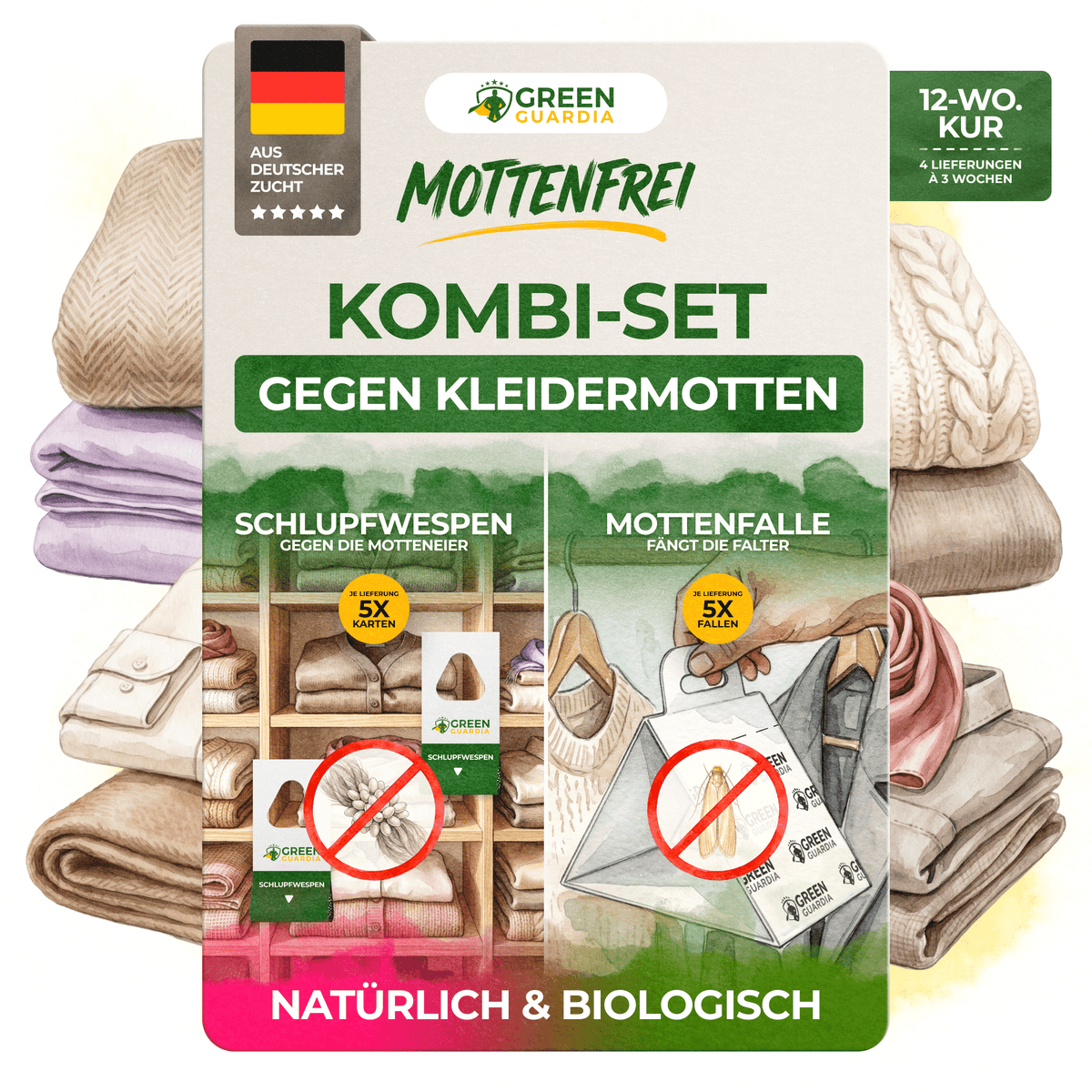


Clothes Moth Bundle: Complete Trichogramma Wasp Treatment + Moth Traps
-
Bundle contents:
-
12-week course with 4 deliveries every 3 weeks
-
Each delivery includes:
-
5x egg wasp cards against clothes moths
-
5x pheromone sticky traps against clothes moths
In stock - with you in 2-4 business days


What our customers say
-
Efficacy
not effective highly effective -
Application
complicated child's play -
Tolerability
concerning very safe
Sparen Sie sorgenfrei im Abo:
Choose options
Clothes Moth Bundle: Complete Trichogramma Wasp Treatment + 20 Moth Traps
Your GREEN GUARDIA Bundle against clothes moths combines Trichogramma wasps to combat moth eggs with pheromone traps to catch male clothes moths. You will receive 4 deliveries at 3-week intervals – each containing 5 Trichogramma wasp cards and 5 clothes moth pheromone traps.
What's in your bundle
- 4 deliveries: at the start and after 3, 6, and 9 weeks
- Per delivery: 5 Trichogramma wasp cards + 5 pheromone traps against clothes moths
- Total: 20 Trichogramma wasp cards + 20 clothes moth pheromone traps
- Four consecutive applications for a treatment lasting about 12 weeks
Combating clothes moths: targeting the eggs
Holes in your wool sweater or signs of feeding on the carpet? The damage is caused by clothes moth larvae. They feed on animal materials like wool, cashmere, fur, and feathers, among other things. Moths prefer to lay their eggs in protected areas near suitable textiles.
This is where Trichogramma wasps come in: they parasitize the moth eggs, preventing further larvae from hatching. The pheromone traps supplement the treatment by catching male clothes moths and helping you monitor moth activity.
How do Trichogramma wasps work?
Trichogramma wasps of the species Trichogramma evanescens are tiny beneficial insects. They hatch from the small cards, search for moth eggs in their vicinity, and lay their own eggs inside them. No clothes moth larva can develop from a parasitized moth egg. These beneficial insects do not sting and will not damage your textiles.
Why four deliveries at three-week intervals?
Clothes moths go through different development stages simultaneously: egg, larva, pupa, and moth. Trichogramma wasps act exclusively against the eggs. Existing larvae and pupae can initially continue to develop, so moths may hatch again and lay eggs later on.
This is why a single application is often not enough. With four deliveries at three-week intervals, you regularly lay out fresh Trichogramma wasp cards. This way, newly laid eggs can also be caught over a longer period. The last application starts after 9 weeks, continuing the treatment for about 12 weeks in total.
What are the pheromone traps for?
The clothes moth pheromone traps lure male moths with a sexual attractant and keep them stuck on an adhesive surface. This allows you to identify where clothes moths are active and monitor the development of the infestation.
The traps do not capture eggs, larvae, or female moths. Therefore, they complement the Trichogramma wasp treatment. You receive 5 traps per delivery, which you can distribute across different infested areas as needed or use as replacements. You do not need to set up all five traps at once.
Application & Placement
- Check textiles: Inspect clothing, carpets, and other vulnerable textiles for holes, webbing, and larvae. Treat infested items according to their material by washing, freezing, or professional cleaning.
- Clean closets: Vacuum shelves, crevices, and joints thoroughly, then dispose of the vacuum cleaner bag outside your home.
- Lay out cards immediately: Distribute the 5 Trichogramma wasp cards as close to the affected textiles as possible upon receipt. Place one card in each separate shelf compartment.
- Set up traps: Place the pheromone traps in the affected areas and check the adhesive surfaces regularly. Replace traps that are heavily covered or dusty.
- Renew every three weeks: Lay out 5 fresh Trichogramma wasp cards with each subsequent delivery.
- Avoid insecticides: Do not use insect sprays or moth repellents with insecticidal properties in the treated areas during the course, as these can also harm the Trichogramma wasps.
What area do five cards cover?
5 Trichogramma wasp cards are generally enough for about 5 m² of treatment area or 5 shelf compartments. The proximity to the infested textiles is crucial. For separate closet compartments, multiple closets, or widely separated infestation points, you may need a higher number of cards. The square meter specification refers to the treated areas, not the total floor space of the room.
Your bundle for the complete treatment: 4 deliveries with a total of 20 Trichogramma wasp cards and 20 clothes moth pheromone traps – for biological control of moth eggs and monitoring of moth activity.
Start your complete Trichogramma wasp treatment against clothes moths now!
Wie viele Karten brauche ich?
Mit GREEN GUARDIA Schlupfwespen bekämpfst du Kleidermotten biologisch – egal ob im Kleiderschrank, in der Kommode oder im Textillager. Eine Karte deckt etwa einen Quadratmeter oder ein Regalfach ab, für einen Standardschrank sind vier Karten die Empfehlung.
Anwendung & Tipps: So nutzt du Schlupfwespen gegen Kleidermotten richtig
- Auslegen: Die Kärtchen direkt nach Erhalt in Schränken, Kommoden oder bei den befallenen Textilien platzieren – so, wie sie geliefert wurden, öffnen musst du nichts. Pro Quadratmeter oder Regalfach wird eine Karte empfohlen, für einen Standardschrank sind vier die Empfehlung. Auf Vorrat legen lassen sich die Karten nicht: Die Schlupfwespen sind nur begrenzte Zeit schlüpfbereit, deshalb gehören sie gleich nach dem Erhalt in den Schrank.
- Wirken lassen: Die Schlupfwespen schlüpfen von selbst und suchen im Umkreis von etwa einem Quadratmeter nach Motteneiern. Die Wirkung beginnt nach wenigen Tagen. In der Nähe der Karten auf chemische Mittel verzichten, sonst schlüpfen die Nützlinge nicht.
- Nach drei Wochen erneuern: Die Karten alle drei Wochen ersetzen, bis der Befall vollständig beseitigt ist. Die Behandlung dauert mehrere Wochen, weil immer wieder neue Eier dazukommen.

- Ablauf der Vollbehandlung: Erste Lieferung an Tag 1 bis 3 gegen die vorhandenen Motteneier, zweite in Woche 3 gegen die neu gelegten, dritte in Woche 6 zur weiteren Reduktion, vierte in Woche 9 als Absicherung gegen verbliebene Eier. So bleibt keine Entwicklungsphase unbehandelt.
- Klebefallen sind erlaubt: Pheromon-Klebefallen dürfen parallel laufen und fangen die ausgewachsenen Falter weg.
- Wirkt die Lieferung leblos? Das ist normal – die Schlupfwespen ruhen in der Verpackung. Leg die Karten einfach wie beschrieben aus, dann schlüpfen sie.
- Vorbeugen: Kleidung regelmäßig kontrollieren, gerade selten getragene Stücke. Wolle, Seide und Pelz luftdicht lagern, etwa in Vakuumbeuteln oder dicht schließenden Boxen. Schränke und Schubladen gründlich reinigen, besonders Ecken, Ritzen und die Flächen unter den Einlegeböden. Neue Kleidungsstücke bei Verdacht vor dem Einlagern lüften oder einfrieren.
- Nachbehandeln: Auch wenn keine Motten mehr zu sehen sind, können versteckte Eier zurückbleiben. Eine Nachbehandlung verhindert, dass daraus neue Larven werden.
- Anleitung zum Download: Gebrauchsanleitung auf Deutsch und Englisch sowie das Sicherheitsdatenblatt findest du auf der Produktseite unter „Datenblätter“.
🛡️ Tipp: Kombiniere die Anwendung mit regelmäßiger Reinigung und luftdichter Lagerung empfindlicher Textilien – so beugst du neuem Befall dauerhaft vor.
Geeignete Einsatzbereiche
- Kleiderschrank & Garderobe: Der Klassiker: eine Karte pro Fach, direkt zwischen Wolle, Seide und Mänteln. Motten legen ihre Eier bevorzugt dort ab, wo es dunkel und ruhig ist.
- Kommode & Schubladen: Für Schals, Mützen und alles, was über Monate unbewegt liegt.
- Teppiche & Läufer: Auch Wollteppiche werden befallen – Karte an einer ruhigen Stelle am Rand platzieren.
- Textillager & Kellerregal: Ideal für Saisonkleidung, größere Textilmengen und Alttextilien, über die ein Befall oft ins Haus kommt.
- Wohnräume mit empfindlichen Textilien: Geruchlos und diskret, deshalb auch im Schlafzimmer und in Ankleiden unproblematisch.
🌱 Gut zu wissen: Die Behandlung mit GREEN GUARDIA Schlupfwespen ist rückstandsfrei, geruchlos und unbedenklich für Menschen, Kinder und Haustiere.
Einzellieferung – gezielter Nachschutz gegen Kleidermotten
Du hast bereits eine 12-Wochen-Kur mit Schlupfwespen gegen Kleidermotten durchgeführt und möchtest den Schutz verstärken? Dann ist unsere Einzellieferung die perfekte Ergänzung – für ein dauerhaft mottenfreies Zuhause, ganz ohne Chemie.
Warum eine 12-Wochen-Kur mit vier Lieferungen?
Kleidermotten durchlaufen einen vollständigen Lebenszyklus von Ei → Larve → Puppe → Motte. Um diesen Zyklus nachhaltig zu unterbrechen, ist eine kontinuierliche Bekämpfung notwendig. Die 12-Wochen-Behandlung mit vier aufeinander abgestimmten Lieferungen zielt gezielt auf jede Entwicklungsphase ab – ganz ohne Rückstände oder Giftstoffe.
Ablauf der 12-Wochen-Kur
- 1. Lieferung (Tag 1–3): Erste Schlupfwespen parasitieren vorhandene Motteneier.
- 2. Lieferung (Woche 3): Bekämpfung neu gelegter Eier und Unterbrechung des Nachwuchses.
- 3. Lieferung (Woche 6): Weitere Reduktion der Mottenpopulation.
- 4. Lieferung (Woche 9): Finale Absicherung gegen verbliebene Eier – für nachhaltigen Erfolg.
Die automatische Lieferung alle drei Wochen stellt sicher, dass keine Entwicklungsphase der Kleidermotten unbehandelt bleibt.
✅ Vorteil: Du bezahlst immer erst dann, wenn deine nächste Lieferung verschickt wird und erhältst vier perfekt aufeinander abgestimmte Lieferungen – ohne Abo, ohne Verpflichtungen.
Setze auf nachhaltige Mottenbekämpfung mit GREEN GUARDIA Schlupfwespen
Jetzt 12-Wochen-Kur starten und Kleidermotten langfristig loswerden!
Was sind Kleidermotten?
Kleidermotten – insbesondere die gemeine Kleidermotte (Tineola bisselliella) – sind kleine, unscheinbare Schädlinge, die sich von Textilien aus tierischen Fasern wie Wolle, Seide, Pelz oder Daunen ernähren.
Häufig gelangen sie unbemerkt über Kleidung, Teppiche oder Alttextilien ins Haus. Dort legen sie ihre Eier in dunklen, ruhigen Bereichen ab – bevorzugt in Kleiderschränken, Kommoden oder Textillagern. Die eigentlichen Schäden verursachen die Larven: Löcher, Fraßspuren und zerfressene Stoffe.
Wie kann ich einem Mottenbefall vorbeugen?
- Kleidung regelmäßig kontrollieren, besonders selten getragene Stücke.
- Textilien aus Wolle, Seide oder Pelz luftdicht lagern – z. B. in Vakuumbeuteln oder dicht schließenden Boxen.
- Schränke und Schubladen gründlich reinigen, insbesondere Ecken, Ritzen und unter Einlegeböden.
- Neue Kleidungsstücke vor dem Einlagern lüften oder einfrieren, wenn ein Verdacht besteht.
- Bei ersten Anzeichen frühzeitig Schlupfwespen einsetzen – je früher, desto wirksamer.
🐛 Tipp: Auch wenn keine Motten mehr sichtbar sind, können versteckte Eier zurückbleiben. Eine Nachbehandlung mit Schlupfwespen verhindert zuverlässig, dass sich neue Larven entwickeln.

GREEN GUARDIA vs. Other providers
What sets us apart from the rest

|

|

Products for home, garden & pet-related areas |

Unclear product information |

Beneficial insects from German breeding |
Unclear origin information |

Developed for practical use |
Complicated selection |

Clear application instructions |
Few application instructions |

Freshly bottled or carefully packaged |
Longer storage or delivery times possible |

German breeding
Beneficial insects from controlled German breeding – quality you can rely on

Expert advice
Application tips and support from our experts – targeted and effective.

Fast help
Our beneficial insects are ready for immediate use and provide targeted help against acute infestations at home or in the garden.

Natural & safe
Safe for everyday use – completely risk-free for children, pets & plants.


Let our customers speak for us.

Natural pest control
At GREEN GUARDIA you will find the right natural solution for every pest problem – completely without chemicals.
Whether trichogramma wasps against moths, predatory mites against spider mites, or nematodes against fungus gnats and slugs – our beneficial insects provide reliable help at home, in the garden, or in the greenhouse.
As a specialist in biological pest control, we stand for quality, innovation, and sustainable impact – in harmony with nature, people, and animals.

Expert advice – Personal & Practical
Our expert advisors support you with targeted application tips and years of experience in natural pest control. Whether you have questions about application, combining different beneficial insects, or choosing the right product – we are here to help you quickly and competently.
FAQ Trichogramma wasps
Do you have questions about our products, application, or shipping? Here you will find the most important answers at a glance. If anything remains unclear, feel free to contact us!

Trichogramma wasps are tiny insects that parasitize pest eggs. They lay their eggs inside the pest eggs, destroying them and stopping the pests from multiplying.
Yes, trichogramma wasps are harmless to humans and pets. They do not sting and do not contain toxic substances.
A “Trichogramma” card is a carrier material onto which the eggs of the trichogramma wasps are applied. These cards are used to combat pest infestations.
The trichogramma wasps begin combating the pest eggs within a few days of placing the cards. The entire process can take several weeks.
Once there are no more pest eggs left, the trichogramma wasps die off naturally.
Signs of a moth infestation include small holes in clothing or food packaging as well as visible moths or their larvae.
Signs of a tortrix moth infestation include drill holes or maggots on fruit.
The cards are securely packaged and sent by mail. Delivery within Germany is handled by Deutsche Post. Please be sure to check your mailbox regularly.
Yes, the trichogramma wasps are packaged in such a way that they survive even cold temperatures.
Follow-up shipments for subscription orders are sent automatically, so you will receive a shipping notification before each follow-up shipment is sent out. If you have any questions, you can contact us at any time.
Live beneficial insects are excluded from returns. However, we are always happy to help if you encounter any problems.
Shipping information
- Fresh shipping: Orders placed from Monday to Friday by 05:00 AM are freshly shipped daily.
- Weekend orders: Orders placed after Friday 5 AM will be shipped the following Monday to guarantee the freshest beneficial insects.
Place the cards near the affected areas, such as closets or pantries. The trichogramma wasps actively search for pest eggs.
No, the cards do not need to be opened. Simply lay them out just as they were delivered.
The treatment usually takes several weeks. The cards should be replaced every three weeks until the infestation is completely eliminated.
Place the cards out immediately upon receipt and avoid using chemical agents near the cards.
Please check the respective product descriptions. There we explain how many cards you need.
Trichogramma wasps only move short distances. Therefore, it is important to place the cards in the immediate vicinity of the infestation.
Yes, pheromone sticky traps can be used in parallel to catch adult pests.
Yes, it is possible that the trichogramma wasps are resting in the packaging. Lay the cards out as instructed so they can hatch.
The treatment takes several weeks because the trichogramma wasps must continuously parasitize new pest eggs. A shorter application is often not enough to completely eliminate the infestation.
It is recommended to use the cards immediately upon receipt, as the trichogramma wasps are only ready to hatch for a limited time.
Use trichogramma wasps regularly and keep affected areas clean and dry.
Common moth species in households are pantry moths and clothes moths.


