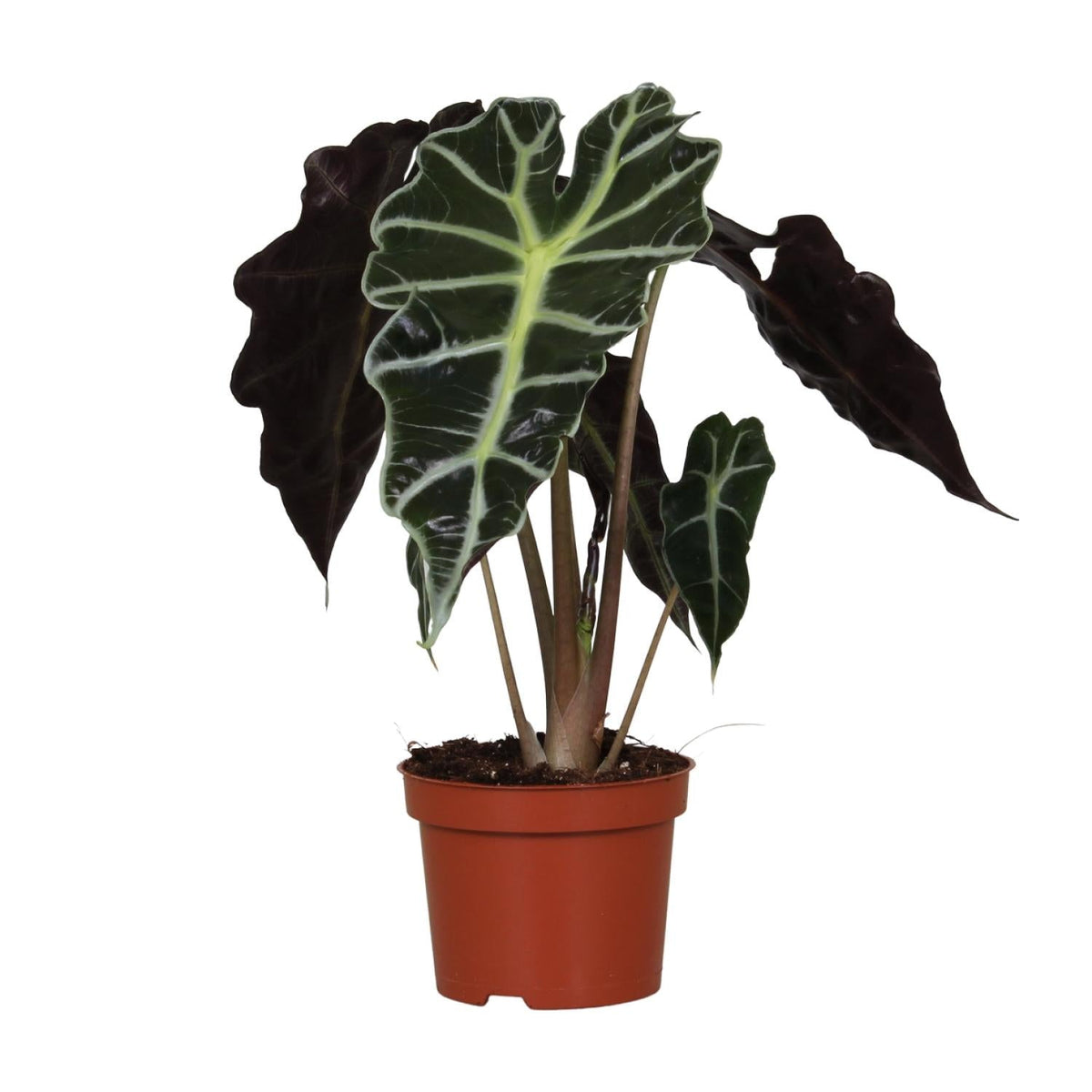


The Alocasia Amazonica ‘Polly’, also known as the Elephant Ear or African Mask plant, is one of the most spectacular additions to any urban jungle. With its deep, dark, arrow-shaped leaves and striking bright white veins, it makes an absolute design statement. Although it has a reputation for being a bit of a diva, the Alocasia Polly can thrive as a houseplant with the right knowledge.
Origin & Characteristics
Contrary to its name, the Alocasia Amazonica Polly does not originate from the Amazon. It is a hybrid whose ancestors hail from the tropical regions of Southeast Asia. It belongs to the Araceae family and therefore loves a warm, humid climate that mimics its natural habitat on the floor of the rainforest.
Appearance & Growth
At a height of about 30 to 50 cm, this variety remains more compact than its larger relatives. The edges of the leaves are wavy, and the undersides often display a deep purple hue. The Alocasia Polly grows from a rhizome (a type of bulb) and often enters a dormancy phase in winter, during which growth slows down.
The Ideal Alocasia Polly Location
Where does the Elephant Ear feel most at home?
Light is the decisive factor. The Alocasia Amazonica Polly location should be bright but without direct sunlight, as the leaves can burn easily. Since it requires high humidity, a bright spot in the bathroom or near a humidifier is ideal. It does not tolerate temperatures below 18 °C.
Caring for your Alocasia Polly & Watering Correctly
When caring for your Alocasia Amazonica Polly, a delicate touch is required. The substrate should be kept consistently moist but must never be waterlogged. Overwatering leads very quickly to rhizome rot in Alocasias. It is best to use room-temperature, low-calcium water and ensure that any excess water is removed from the saucer immediately.
Typical Problems & Solutions
Yellow leaves or brown edges
If your Alocasia Amazonica Polly develops yellow leaves, it is often due to overwatering or a location that is too cold. Brown, dry edges, on the other hand, are a classic sign of low humidity.
Natural support against pests
Alocasias are prone to spider mites, especially when the air is dry from heating in the winter. Neem oil has proven effective for strengthening overall plant health and as a supportive care measure. It protects the striking leaves in a natural way and helps maintain their resistance to external factors.
Propagation
The easiest way to propagate is by dividing the rhizome during repotting in the spring. You can carefully separate small bulbils and plant them in their own substrate to grow new Alocasia Polly plants.
Frequently Asked Questions about Alocasia Polly
Is the Alocasia Amazonica Polly toxic to pets?
Yes, the Elephant Ear is toxic to cats and dogs in all parts of the plant because it contains calcium oxalate crystals. These can cause irritation in the mouth and throat.
Why is my Alocasia losing leaves in winter?
This can be part of a natural dormancy phase. When light intensity drops, the plant sometimes pulls nutrients from the outer leaves back into the bulb. Reduce watering significantly during this time.
How often should I fertilize my Elephant Ear?
During the growth phase from March to September, the Alocasia will appreciate liquid houseplant fertilizer at half-strength every two weeks.
Take Action Now: Get the Tropical Look
The Alocasia Amazonica ‘Polly’ is undoubtedly a plant with character that rewards a little extra attention. If you provide high humidity and a bright location, it will become the absolute star of your collection. Are you ready for this botanical beauty? Discover our healthy Alocasia Amazonica Polly in a 12 cm pot now and bring an exotic flair into your home!
💧 Pro tip: Place your Alocasia on a saucer with pebbles and water (a pebble tray). The evaporating water will increase the humidity right around the leaves without the roots sitting in the water.